
Scenario Prioritization in AI Agents: Managing Competing Goals, Ambiguity, and Edge Cases
Why prioritizing scenarios is a core challenge in autonomous AI design, and practical architectural strategies to resolve conflicting objectives, ambiguous intent, and dynamic context shifts.
Prioritizing different scenarios is one of the foundational challenges in production AI design. As autonomous systems evolve from simple text completion tools into complex agentic assistants executing tools, querying data repositories, and managing long-horizon tasks, they constantly juggle competing goals, shifting conversational contexts, and strict resource envelopes.
When an agent cannot reliably prioritize which instruction, constraint, or scenario takes precedence, the failure mode is rarely subtle. It manifests as safety bypasses, infinite looping, context degradation, or broken workflows.
The Scenario Prioritization Architecture
To manage competing constraints without bloating prompt windows or introducing brittle edge-case patches, production systems decouple triage, precedence rules, and automated evaluation into distinct architectural layers:
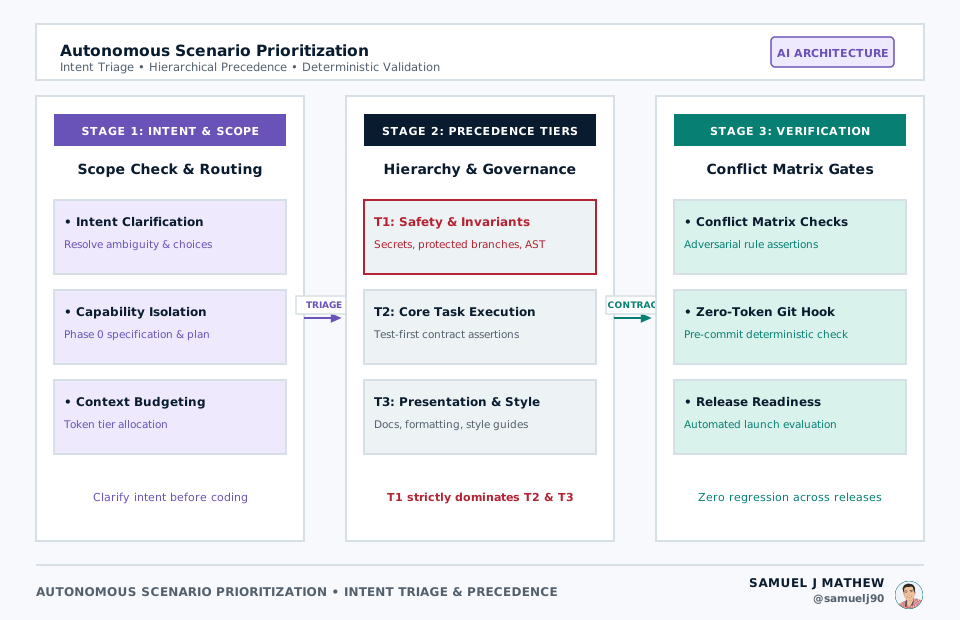
Why Scenario Prioritization Is Difficult
Unlike traditional software architectures where execution order is explicitly handled via static conditional branching, agentic systems rely heavily on probabilistic model interpretation of system instructions, runtime context, and user inputs. This creates four primary sources of friction:
1. Conflicting Objectives
Prompts and agents must balance speed, operational cost, thoroughness, and safety simultaneously. Optimizing for one objective almost invariably degrades another:
- Increasing thoroughness (deep audits, exhaustive searches, multi-step validation) increases latency and token consumption.
- Optimizing for speed and cost risks missing critical context or generating superficial solutions.
- Enforcing strict safety boundaries without clear contextual thresholds can lead to over-refusal and degraded user experience.
2. Ambiguous Context
Users rarely state their exact priority level or operational tolerance upfront. When a user asks “Why is this service failing?”, the agent must infer on the fly whether the user needs:
- A fast high-level diagnostic hypothesis,
- An end-to-end trace with automated fixes and regression checks, or
- An urgent rollback because critical production workflows are impacted.
Without clear triage logic, agents often default to verbose, unhelpful middle-grounds that waste tokens and time.
3. Edge-Case Interference
As systems mature, teams tend to patch edge-case failures with localized rules (e.g., “If the user asks about X, always do Y first”). Over time, these well-intentioned overrides accumulate, creating unintended side effects where rare edge-case rules accidentally clobber core, everyday workflows.
4. Static vs. Dynamic Rules
Hardcoded, static priority lists work smoothly for linear, predictable tasks. However, in agentic environments, priorities frequently invert mid-stream. A task that starts as a low-priority documentation refactor may uncover an urgent security vulnerability midway through, demanding an immediate dynamic shift into high-priority remediation mode.
Common Strategies to Manage Priorities
To build resilient agents that remain dependable under real-world ambiguity, modern AI architectures employ four core structural patterns:
1. Strict Tiered Rule Hierarchies
Establish explicit precedence tiers so non-negotiable constraints always dominate secondary preferences:
| Precedence Tier | Scope & Responsibilities | Mutability | Examples |
|---|---|---|---|
| Tier 1: Safety & Invariants | Absolute boundaries, regulatory compliance, workspace sandboxes | Non-negotiable | Zero credential leakage, sandbox escape prevention, immutable test contracts |
| Tier 2: Core Task Execution | Functional correctness, tool orchestration, architectural alignment | Adaptive | AST verification, correct API parameter schemas, test execution loops |
| Tier 3: Presentation & Style | Formatting conventions, tone, syntax sugar, verbosity | Soft preference | Markdown styling, code formatting nuances, commentary density |
Precedence Invariant: Lower-tier directives can never override higher-tier constraints. Even if a user explicitly requests concise unformatted output, safety audits and compilation verification cannot be bypassed.
2. Intent-Based Routing
Rather than loading a monolithic prompt with all possible instructions, insert a lightweight classifier or triage step upfront. This triage layer inspects the user prompt, determines the primary scenario (e.g., quick query, structural refactor, incident remediation), and routes execution to a specialized agent profile or tailored skill set.
3. Explicit Fallback Logic
Define deterministic behaviors for situations where priorities collide or context is missing. Instead of guessing:
- If confidence drops below a threshold, trigger a focused clarifying question rather than executing speculative changes.
- In multi-path scenarios with equal priority, default to the least destructive, non-mutating action first (e.g., inspecting/reading before writing or deleting).
4. Weighted Scoring and Utility Thresholds
In autonomous multi-agent systems and complex tool-use loops, discrete boolean rules often fall short. Assigning confidence scores or utility weights to candidate actions enables the agent to evaluate the highest-value step dynamically based on token cost, execution time, and expected utility:
$$\text{Action Utility} = P(\text{Success}) \times \text{Expected Value} - (\text{Token Cost} + \text{Latency Penalty})$$
Best Practices for Skill Design
When engineering modular agent skills, keeping scenario logic clean requires disciplined maintenance:
Keep Instructions Modular
Avoid stuffing every rule into a root system prompt. Split large prompt files into smaller, scenario-specific skills with concise trigger conditions. A skill should only be activated into the context window when its exact domain is relevant, preserving active attention and preventing context dilution.
Test Against Conflict Matrices
Unit testing AI systems requires more than verifying happy paths. Build evaluation sets specifically designed to pit rules against each other in a conflict matrix:
                  ┌───────────────────────┬─────────────────────────┬─────────────────────────┐
                  │ Rule A: Maximum Speed │ Rule B: Full AST Audit  │ Rule C: Format Strictness│
┌─────────────────┼───────────────────────┼─────────────────────────┼─────────────────────────┤
│ Conflict Test 1 │ Speed vs. Safety      │ → Block bypass (T1 wins)│ —                       │
│ Conflict Test 2 │ Speed vs. Formatting  │ —                       │ → Speed overrides T3    │
│ Conflict Test 3 │ Audit vs. Ambiguity   │ → Ask user first        │ —                       │
└─────────────────┴───────────────────────┴─────────────────────────┴─────────────────────────┘
Systematically evaluating your agent against conflicting scenarios ensures that your tiering and triage mechanisms behave deterministically when under pressure.
Conclusion
Scenario prioritization is not an afterthought in agent design—it is the difference between an unstable prototype and a reliable production assistant. By combining tiered rule hierarchies, modular skills, upfront intent routing, and evaluation against conflict matrices, engineering teams can build AI systems that navigate competing goals with consistent, predictable precision.